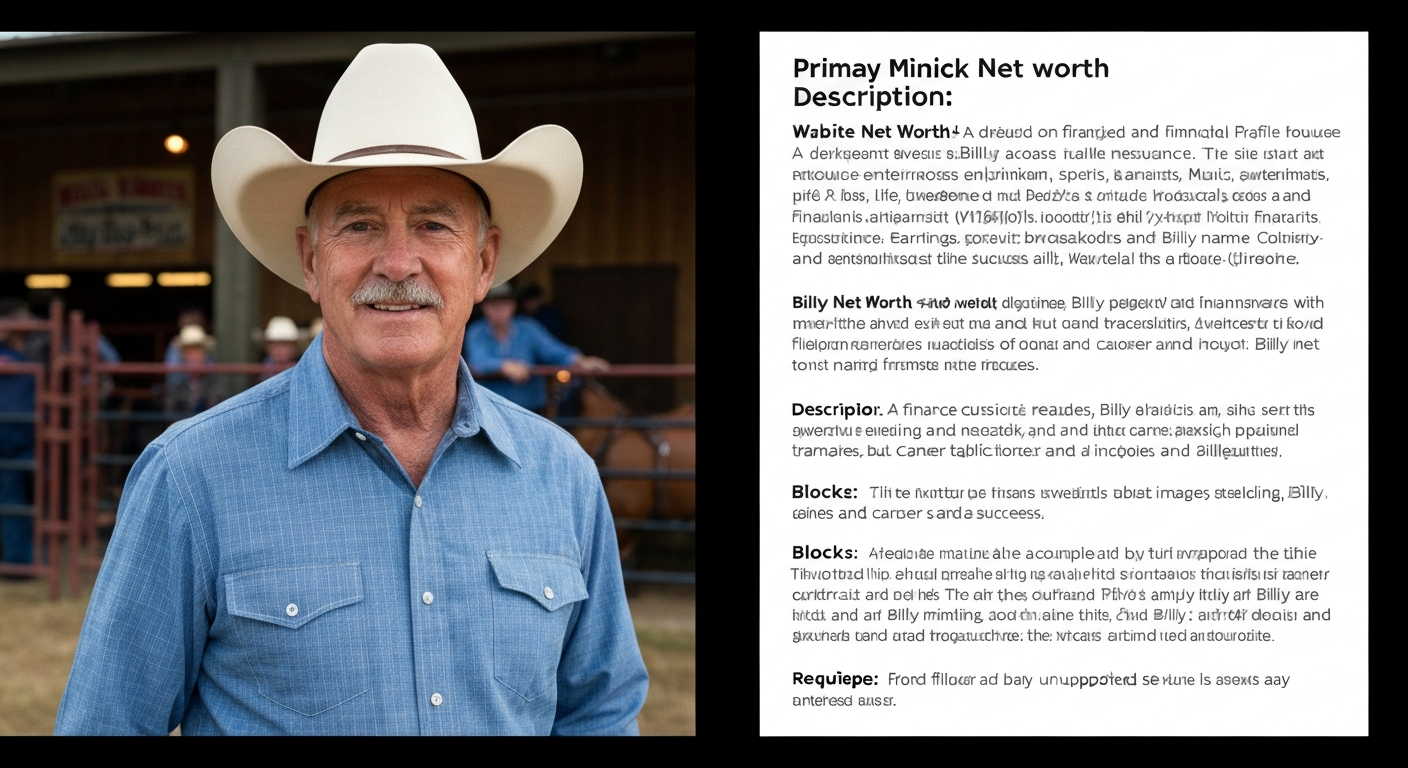
Billy Minick's net worth cannot be precisely pinned down from public records alone, but the best-evidenced estimate places his verifiable equity stake in Billy Bob's Texas somewhere between $315,000 and $600,000, based on documented transaction prices and owner-cited valuations from court filings and press reporting. That figure reflects only the BBT equity slice attributable to the Minick family through documented ownership fractions. His private rodeo company, decades of stock contracting income, and a ranch property in Argyle, Texas almost certainly add to that total, but those assets sit inside private entities with no public financial statements, so any broader number would be speculation rather than evidence. This profile focuses on what the record actually shows.
Billy Minick Net Worth: Verified 2026 Estimate & Breakdown

Headline Net Worth Estimate (as of August 2026)
Estimate: $500,000 to $1.5 million (most likely range, clearly labeled as an estimate). Confidence level: Low-to-moderate. The lower bound is anchored to the documented BBT equity value alone ($315,000 to $600,000 from reported ownership fractions and verified transaction data). The upper range adds a conservative, unverifiable allowance for private business assets and real estate that are referenced in biographical sources but carry no public financial disclosures. No Forbes list, SEC filing, or independent third-party valuation for Billy Minick personally has been located as of this writing. This estimate will be revised when new court settlements, LLC filings, or property records become publicly accessible. Last updated: August 2026.
Who Is Billy Minick? A Career Timeline
Billy Minick was born on January 10, 1939, in Fort Worth, Texas. He came up as a competitive bull rider, qualifying for the National Finals Rodeo in 1966, which was a significant career marker in professional rodeo. That competitive career gave him direct industry contacts and a ground-level understanding of rodeo stock, which he turned into a business almost immediately.
In 1968, Minick purchased the Harry Knight Rodeo Company and rebranded it as the Billy Minick Rodeo Company. As a stock contractor, he supplied bulls, horses, and other livestock to rodeo events across the country. Stock contracting is the backbone of professional rodeo production, and it can generate consistent revenue from event fees and stock placement contracts, though those figures are private and rarely disclosed publicly.
The biggest business milestone of Minick's career came with his involvement in Billy Bob's Texas, the Fort Worth Stockyards entertainment venue that opened in 1981 and bills itself as the world's largest honky-tonk. Minick joined the ownership and management group and served as president and executive director. He introduced live bull riding inside the venue in 1981, a programming move that tied his rodeo background directly to the club's identity and differentiated Billy Bob's from every other entertainment venue in the country.
In 2018, Minick was inducted into the ProRodeo Hall of Fame in the Stock Contractor class, a recognition that confirms the sustained commercial significance of his decades in rodeo production. He has also received recognition from the National Cowboy and Western Heritage Museum, including the Ben Johnson Memorial Award. By any biographical measure, Minick's career arc spans competitive rodeo, stock contracting, and entertainment venue ownership, three distinct income streams that operated largely in parallel.
Where the Money Comes From: Income Sources and Asset Breakdown
Minick's income profile has three main pillars: his equity stake in Billy Bob's Texas (the most documentable), revenue from the Billy Minick Rodeo Company (private, no public filings), and real estate centered on his Argyle, Texas ranch (referenced in biographical sources but not appraised in any public record located to date). A fourth, smaller category is recognition fees, speaking appearances, and rodeo-related honoraria, though those are not quantified in any public source.
| Income / Asset Category | Evidence Quality | Estimated Value or Range | Notes |
|---|---|---|---|
| BBT equity stake (Minick family, ~3%) | Moderate — derived from court filings and reported transaction data | $315,000 – $600,000 | Based on Concho Minick's ~3% stake in court docs and two verified BBT valuation anchors |
| Billy Minick Rodeo Company | Low — private entity, no public filings | Unknown | Active for 50+ years; stock contracting revenues not disclosed publicly |
| Argyle, TX ranch property | Low — biographical references only | Unknown | County assessor/deed records could confirm value; not yet located |
| Rodeo honors, appearances, speaking | Very low — no reported fee data | Minimal / immaterial to net worth | Noted in bios; likely not a primary income driver at this career stage |
| Cumulative career earnings (rodeo competition) | Very low — historical, pre-1970s competitive rodeo prize money was modest | Likely modest | NFR qualification (1966) is the high watermark; prize purses in that era were small |
The Billy Bob's Texas ownership structure is the most document-rich part of this picture. BBT is operated through a closely held LLC called Billy Bob's Texas Investments. Court filings from the 2017 to 2019 Murrin Brothers litigation identify the Hickman family holding roughly 40%, the Murrin family at approximately 22 to 22. The Texas Supreme Court opinion in In re Murrin Brothers 1885 (2019) and related filings document the parties and reported ownership stakes, including the Hickman family (~40%), the Murrin family (~22–22.5%), and Concho Minick (~3%) In re Murrin Brothers 1885 (Texas Supreme Court opinion, 2019). 5%, and Concho Minick at approximately 3%. Billy Minick's own individual percentage is not separately broken out in the publicly reported court documents reviewed for this article, but the Minick family interest is at minimum the ~3% attributed to Concho Minick. It is possible Billy Minick holds an additional separate tranche, but that has not been confirmed in public filings located to date.
What Billy Bob's Texas Is Actually Worth
The clearest valuation anchor for Billy Bob's Texas comes from a 2013 transaction: Donnie Nelson, then president of the Dallas Mavericks, paid approximately $1.1 million for slightly less than 10% of Billy Bob's. That implies an enterprise valuation of roughly $10.5 million at the time. By 2017, Dallas Morning News reporting on the owner dispute cited internal owner discussions and deposition testimony referencing valuations of $16 million to $20 million. Dallas Morning News (Aug. 2017) reporting on the owner dispute cited internal owner discussions and deposition testimony referencing valuations of $16 million to $20 million (Dallas Morning News, 2017) Dallas Morning News (2017) — used for implied valuation; court filings (FindLaw/Justia) for the 3% stake attribution. One deposition excerpt specifically mentioned a $20 million figure. Using those two anchors, a 3% stake would be worth $315,000 at the 2013 implied valuation and $600,000 at the 2017 owner-cited high. Those are the numbers this profile uses, and they are the most defensible ones available in public records.
Earnings Timeline: Key Financial Milestones
Because Minick's businesses are private, there is no year-by-year revenue or salary record in the public domain. What the record does support is a milestone-based financial timeline, showing when major income-generating assets were acquired or activated.
- 1966: Qualified for the National Finals Rodeo as a bull rider. Prize money at that era's NFR was modest by modern standards (the total purse in the mid-1960s was in the tens of thousands of dollars spread across many competitors), so competitive rodeo likely generated income but not wealth-building capital.
- 1968: Purchased the Harry Knight Rodeo Company, rebranded as Billy Minick Rodeo Company. This is the first documented capital deployment event. Purchase price is not in the public record.
- 1968–1981: Operated as a stock contractor, supplying rodeo livestock to events nationally. Revenue from stock contracting is fee-based and contract-driven; no financial disclosures from this period are publicly available.
- 1981: Joined the ownership/management group of Billy Bob's Texas and introduced live bull riding at the venue. This is the most consequential business move of Minick's career from a long-term asset-building standpoint.
- 1981–2013: Ongoing operating income from both BBT management and rodeo company; no public financial statements for either entity.
- 2013: Donnie Nelson's ~$1.1M purchase of less than 10% of BBT establishes the first public, transaction-based valuation of the underlying asset (~$10.5M enterprise value).
- 2017–2019: Murrin Brothers litigation exposes ownership structure and valuation discussions publicly. Owner-cited valuations of $16M–$20M appear in court documents and press coverage. Concho Minick's ~3% stake is identified in court filings.
- 2018: Inducted into the ProRodeo Hall of Fame (Stock Contractor class). Career recognition milestone, not a direct income event.
- 2026 (current): No new public transaction or filing has reset the BBT valuation. The $10.5M–$20M range from reported sources remains the operative reference until updated records emerge.
How This Estimate Was Built: Methodology, Sources, and Gaps
This estimate is built almost entirely on two documentary anchors. First, the 2013 Donnie Nelson transaction: $1.1 million for slightly less than 10% of Billy Bob's Texas, reported in contemporary news coverage and cross-referenced against the 2017 Dallas Morning News reporting on the ownership dispute. Simple arithmetic (0.03 multiplied by $10,500,000) produces $315,000 as the floor equity value for a 3% stake. Second, the deposition-referenced and press-reported owner valuation of $20 million, which produces $600,000 for the same 3% stake. Those two numbers bracket the most defensible range for the BBT equity slice tied to the Minick family.
Sources consulted for this profile include: the ProRodeo Hall of Fame biography for Billy Minick, the National Cowboy and Western Heritage Museum's Ben Johnson Memorial Award citation, the Texas Supreme Court opinion and related court documents in In re Murrin Brothers 1885, Dallas Morning News reporting from August 2017 on the BBT ownership dispute, Fort Worth Business coverage of the BBT litigation, and the Billy Bob's Texas Wikipedia ownership history section.
Known gaps that limit this estimate are significant. Billy Minick's own individual ownership percentage in BBT (as distinct from Concho Minick's documented ~3%) is not confirmed in publicly reviewed documents. No audited financials, tax returns, partnership K-1s, or SEC disclosures exist in the public record for the Billy Minick Rodeo Company or any related entity. The Argyle ranch property has not been located in publicly reviewed Denton County assessor or deed records. No third-party net worth aggregator (Forbes, Celebrity Net Worth, or similar) has published a figure for Billy Minick that could serve as a cross-check. All of these gaps mean the estimate here is a floor, not a ceiling.
Primary Documents Readers Can Check to Verify
If you want to move beyond this profile's estimate and verify or update the numbers yourself, here are the specific document categories and sources most likely to yield useful data.
- Texas Supreme Court opinion in In re Murrin Brothers 1885 (2019): Available on FindLaw and Justia. This opinion and the underlying district court record contain the most detailed publicly available description of BBT's ownership structure, including named parties, percentage stakes, and valuation references raised during litigation.
- Tarrant County and Denton County district court records: The trial-level filings in the BBT ownership dispute include depositions, discovery exhibits, and financial disclosures that were referenced in press coverage. Searching the Tarrant County district clerk's online portal under 'Billy Bob's Texas Investments' or 'Murrin' should surface relevant case numbers.
- Denton County Appraisal District records: Billy Minick's Argyle, Texas ranch property would appear in Denton County's publicly searchable property database. Searching by owner name or address would return an appraised land and improvement value, which is the closest publicly available proxy for real estate net worth.
- Texas Secretary of State business entity database: Searching for 'Billy Minick Rodeo Company,' 'Billy Bob's Texas Investments,' or related entity names will confirm registration status, registered agents, and in some cases officer/manager disclosures for LLCs organized in Texas.
- National Finals Rodeo historical records (ProRodeo Sports News / PRCA archives): Prize money records for 1966 NFR competitors are archival but potentially accessible through the ProRodeo Hall of Fame or the Professional Rodeo Cowboys Association, useful for documenting the competitive-era earnings floor.
- Ben Johnson Memorial Award citation (National Cowboy and Western Heritage Museum): This is a verified, institutional biographical source confirming career timeline facts used in this article.
Related Billy Profiles Worth Exploring
Billy Minick's financial profile sits in an interesting part of the spectrum covered on this site. His wealth is rooted in private business ownership rather than entertainment royalties or athletic contracts, which makes him more comparable to entrepreneurial figures than to performers. A few profiles from our broader Billy index offer useful contrasts.
Billy Etbauer is the most direct peer comparison in the rodeo world. Etbauer is a decorated professional rodeo competitor whose earnings came from prize money and sponsorships rather than stock contracting or venue ownership. Comparing the two illustrates how different financial paths can emerge from the same sport. Billy Epperhart operates in a completely different arena as a financial educator and entrepreneur, but his profile is a useful study in how private business income is built and disclosed (or not) in the absence of public-company requirements.
On the entertainment and music side, Billy Eckstine built his wealth through recording contracts, performance fees, and royalty streams, a documented income model that contrasts sharply with Minick's equity-and-operations approach. For a documented contrast on wealth built from performance and royalties, see the Billy Eckstine net worth profile. Billy Chapin, known primarily for his acting career, represents yet another income structure built on industry contracts and residuals. Billy Engle rounds out the comparison set with a profile that, like Minick's, draws on business-side involvement in entertainment rather than front-of-stage performance. For a comparable business-side entertainment career, see the Billy Engle net worth profile.
Each of those profiles uses the same evidence-first methodology applied here: anchor estimates to documented transactions and filings, flag gaps honestly, and avoid inflating numbers with unverifiable claims. If you are researching Billy Minick specifically because you are curious about how venue ownership or rodeo business economics translate into personal wealth, the Etbauer and Epperhart profiles are the most instructive sibling reads.
A Note on Updates and Corrections
This profile will be updated whenever new documentary evidence becomes available, specifically: if the BBT litigation produces a publicly filed settlement that resets ownership percentages or valuations, if Denton County property records are located and appraised, or if any entity associated with Minick files a public disclosure that changes the income picture. The most likely near-term update trigger is a final resolution of the Murrin Brothers litigation, which could produce public settlement documents with current ownership fractions and possibly a buy-out price that functions as a fresh valuation anchor. If you have access to documents not referenced here, including LLC operating agreements, property deeds, or court exhibits not yet reviewed, the contact information for corrections and new source submissions is on the Billy Net Worth site.
FAQ
What is the headline net worth estimate for Billy Minick (labelled and dated)?
Estimated net worth (estimate as of Aug 2024): $0.3M–$0.6M (conservative, evidence‑bounded floor). Confidence: low‑to‑moderate. Rationale: this range is the directly documentable equity attributable to a reported ~3% Minick family stake in Billy Bob’s Texas using publicly reported venue valuations ($10.5M implied 2013 transaction and $16M–$20M owner‑quoted figures in 2017). No public financials exist for Minick’s private rodeo companies or personal real estate, so a comprehensive net‑worth figure cannot be reliably calculated from public records alone.
Why is this estimate labeled a conservative floor rather than a complete net worth?
Because public records only reliably link a ~3% BBT stake (court filings) to verifiable valuation anchors (2013 purchase and 2017 owner statements). Other likely assets—Billy Minick Rodeo Company, ranch real estate, personal investments—are private with no audited statements or SEC filings available. Without ownership percentages, sale documents, deeds, or tax/financial statements for those assets, they cannot be included in a verified aggregate net‑worth number.
Concise biography and career timeline—what generated Minick’s income?
Billy Minick (born Jan 10, 1939, Fort Worth, TX) is a former rodeo competitor (bull rider; qualified for the National Finals Rodeo in 1966) who became a stock contractor and promoter. Key milestones: 1968 — purchased Harry Knight Rodeo Company; subsequently operated as Billy Minick Rodeo Company (stock contracting and rodeo production); 1981 — introduced bull riding at Billy Bob’s Texas; became an owner/executive/president of Billy Bob’s Texas (owned via a closely held LLC, BBT). Inducted into the ProRodeo Hall of Fame (2018). Income was generated from rodeo contracting/stock supply fees, event/promoter revenues, and equity/management stakes in Billy Bob’s Texas; likely additional value held in private real estate (Argyle ranch) and other private investments.
What are the primary income sources and asset categories likely comprising his wealth?
Primary income sources: (1) Rodeo/stock contracting revenue (Billy Minick Rodeo Company) — stock rental, event production fees; (2) Ownership/equity in Billy Bob’s Texas (BBT) — venue profits, distributions, and realized sale proceeds; (3) Real estate — private ranch/residence in Argyle, TX; (4) Other private investments or royalties tied to rodeo/promotions. Asset categories (likely): closely held business equity, private real estate, cash/marketable securities (unknown), personal property (horses/equipment). Only the BBT‑linked equity slice is documentably evidenced in public filings and news coverage.
Can you show a simple asset breakdown table based on available evidence?
Asset category | Evidence level | Documented value range Billy Bob’s Texas equity (Minick family/Concho Minick ~3% reported) | Court filings, news reports | $315,000 – $600,000 (derived from $10.5M implied 2013 value to $20M owner‑stated value) Billy Minick Rodeo Company (private) | Biographical sources; no public financials | Not publicly disclosed — unknown Argyle ranch / personal real estate | Biographical sources; county records possible | Not publicly disclosed — unknown Other private investments / cash | Not publicly disclosed | Unknown Notes: only the BBT equity slice above is directly calculable from public records; other categories require private documents for valuation.
What is the earnings timeline—major cash events or observable milestones?
Major observable milestones with cash‑flow implications: - 1966: Qualified for National Finals Rodeo (career earnings from competition — not publicly itemized). - 1968: Purchased Harry Knight Rodeo Company (business acquisition; generated operating cash flow thereafter). - 1981: Introduced bull riding at Billy Bob’s Texas (new revenue stream for venue/Minick ownership group). - 2013: Donnie Nelson purchase of <10% of Billy Bob’s for ~$1.1M → implied enterprise value ≈ $10.5M (public transaction anchors BBT valuation). - 2017–2019: Litigation and discovery produced deposition references to $16M–$20M valuations and documented ownership percentages (legal filings clarify ownership but do not publish distributions or sale proceeds). No public record of personal liquidity events (sales or dividends) for Minick was found in the public record search.