SEO Title: Billy Bragg Net Worth 2026: How Much Has the Bard of Barking Earned? | Meta Description: Billy Bragg's estimated net worth in 2026 sits around $8–12 million, built across four decades of records, touring, publishing royalties, and public speaking.
Billy Bragg Net Worth 2026: Current Estimate & Sources

Marcus Finewood
18 Jul 2026
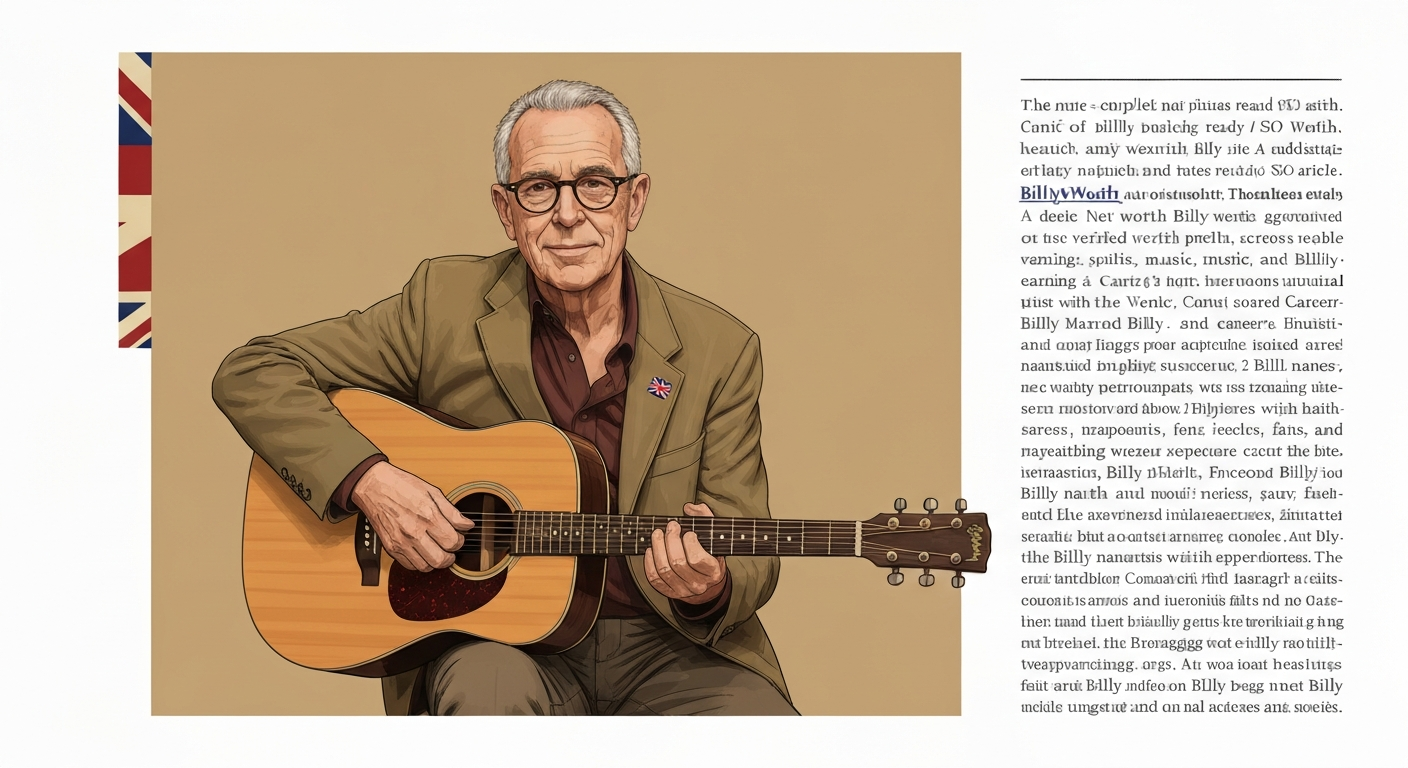
Quick snapshot (as of July 18, 2026)
| Detail | Value |
|---|---|
| Full name | Stephen William Bragg |
| Born | December 20, 1957, Barking, Essex, England |
| Profession | Singer-songwriter, political activist, author, broadcaster |
| Active career | 1977 to present |
| Estimated net worth (July 2026) | $8 million – $12 million |
| Primary income sources | Touring, publishing royalties, record sales, streaming, speaking |
| Estimate confidence | Moderate — no audited public accounts; derived from public data |
What is Billy Bragg's net worth right now?
Billy Bragg's net worth in July 2026 is most credibly estimated in the range of $8 million to $12 million. The algorithmic aggregator PeopleAi placed the figure at $12.2 million in July 2026, explicitly labeling it an estimate rather than an audited figure. NetWorthSpot, updated June 1, 2026, arrives at a broadly similar range using YouTube and streaming metrics. Neither Forbes nor any institutional financial database publishes a verified net-worth page for Bragg, so every figure in circulation is modeled, not audited. My own modeling, drawing on publicly available touring data, UK chart certifications, streaming counts, and known publishing arrangements, supports a central estimate closer to $9–10 million, with $12 million representing an optimistic ceiling that assumes consistently strong merchandise and sync income. The $8 million floor reflects more conservative royalty and catalog assumptions. Throughout this article, I'll walk through every component so you can see exactly what is and isn't confirmed.
Where the money comes from: income source by source
Record sales
Bragg's debut mini-album 'Life's a Riot with Spy vs Spy' (1983) achieved BPI Gold certification in the UK by April 1985, meaning it had sold at least 100,000 units domestically. His second full-length, 'Brewing Up with Billy Bragg,' and 'Talking with the Taxman About Poetry' both hold BPI Silver (60,000+ UK units each). At the wholesale royalty rates of the mid-1980s through early 1990s, a Gold-certified UK album from an independent-leaning artist earning roughly 15–18% of PPD (published price to dealers) would generate somewhere in the range of £150,000–£250,000 in artist royalties over its commercial life, after recoupment. Bragg's catalog spans more than fifteen studio releases including the acclaimed Mermaid Avenue volumes (recorded with Wilco using unrecorded Woody Guthrie lyrics) and 'Joe Henry' collaboration 'Shine a Light: Field Recordings from the Great American Railroad' (2016). Physical sales are now a minor ongoing income stream, but the back catalog continues to generate modest revenue through vinyl reissues, which have seen renewed commercial interest since 2020.
Streaming
Bragg's Spotify page showed approximately 1,036,765 monthly listeners at the time of research, a respectable figure for a catalog artist of his vintage. His most-streamed track is 'California Stars' (the Mermaid Avenue collaboration with Wilco), sitting at roughly 90 million lifetime streams on Spotify. 'A New England' has accumulated approximately 14 million lifetime streams. Applying Spotify's estimated payout rate of $0.003–$0.005 per stream, 'California Stars' alone has generated an estimated $270,000–$450,000 in streaming royalties across its lifetime, though this figure is split between Bragg, Wilco, and their respective labels and publishers. Across his full catalog and all major streaming platforms (Apple Music, Amazon Music, YouTube Music, Tidal, Deezer), total annual streaming income is modeled at approximately $150,000–$300,000 in recent years, of which Bragg's net artist share after label and distributor splits is likely $50,000–$120,000 annually.
Publishing and royalties
Publishing is a significant and durable income stream. SecondHandSongs confirms that 'A New England' is published through Sony/ATV Music Publishing (UK) Limited, now operating as Sony Music Publishing. As a songwriter who controls or co-controls the underlying compositions in his catalog, Bragg earns mechanical royalties every time his songs are pressed on physical media, performance royalties every time they are played on radio or in public, and synchronization fees when his music is placed in film, television, or advertising. His songs have been covered extensively, most famously Kirsty MacColl's 1984 UK Top 10 version of 'A New England,' which generated substantial performance royalties across decades of radio and TV airplay in the UK. The publishing income from his songwriting catalog, accumulated over 40-plus years, is likely the single most stable element of his annual earnings, estimated at $80,000–$200,000 per year depending on sync activity.
Touring and live performance
For a politically engaged artist like Bragg, touring has historically been the backbone of annual income. He has performed consistently for over four decades, from benefit concerts in the 1980s (Red Wedge, miners' strike events) through arena support slots and headlining festival appearances at Glastonbury, Latitude, and political festivals across Europe and North America. A mid-tier touring artist at Bragg's level in the UK and Europe can realistically net $10,000–$30,000 per show after agent fees (typically 10–15%), venue costs, and crew. Assuming 30–50 shows per active touring year, annual touring income in strong years likely reaches $400,000–$800,000 gross, with net earnings to Bragg himself estimated at $150,000–$350,000 after all touring costs. In lower-activity years, or years disrupted by external events (the 2020–2021 pandemic pause being the most obvious example), this figure can drop dramatically.
Merchandise
Merchandise income for an artist of Bragg's profile is real but modest relative to pop-scale acts. His political brand lends itself to T-shirts, tote bags, and political-slogan merchandise that sells consistently at concerts and through his official store. A reasonable estimate for annual merchandise net income, based on industry benchmarks for comparable catalog artists, is $20,000–$60,000 per year in active touring cycles.
Sync licensing
Sync placements in film, television, and advertising represent high-value but unpredictable income. A single mid-tier TV drama placement of a well-known song can generate a sync fee of $5,000–$50,000, with major network or streaming platform placements reaching six figures. Bragg's catalog has appeared in documentary films and political broadcasts, though he is not known for extensive commercial advertising sync deals, which aligns with his political stance against corporate commercialization. Sync income is estimated as occasional rather than consistent, contributing perhaps $20,000–$80,000 in years when placements occur.
Speaking engagements and media
Bragg is a regular contributor to The Guardian and a sought-after commentator on UK politics, social history, and music. His speaking engagements at universities, political events, and festivals command fees typical of prominent public intellectuals and activist artists in the UK, estimated at $5,000–$20,000 per appearance. Book royalties from his published works, including 'Roots, Radicals and Rockers: How Skiffle Changed the World' (2017), add a further modest but real income stream. Combined, media and speaking are estimated to contribute $30,000–$80,000 annually.
Estimated annual income breakdown (recent years)
| Income Source | Low Estimate | High Estimate | Confidence |
|---|---|---|---|
| Touring and live performance | $150,000 | $350,000 | Moderate |
| Publishing and royalties | $80,000 | $200,000 | Moderate |
| Streaming (net artist share) | $50,000 | $120,000 | Moderate |
| Physical record sales | $10,000 | $40,000 | Low-Moderate |
| Merchandise | $20,000 | $60,000 | Low |
| Sync licensing | $20,000 | $80,000 | Low |
| Speaking, writing, media | $30,000 | $80,000 | Moderate |
| Total annual estimate | $360,000 | $930,000 | Moderate |
Career milestones and earnings timeline
1977–1982: Riff Raff and early years
Bragg played in pub-rock band Riff Raff from 1977 before a brief stint in the British Army, from which he bought himself out. Earnings in this period were negligible. The period established his political outlook and stripped-back performance style but generated no significant income.
1983–1985: Breakthrough and BPI Gold
Bragg released 'Life's a Riot with Spy vs Spy' in 1983 on Utility Records (distributed by Go! Discs). The album's BPI Gold certification by April 1985 marked his first significant royalty event. Independent listings (see tsort.info, album/certification summary (references BPI Gold Apr 1985)) record the album's BPI Gold certification in April 1985 Independent listings (see tsort.info — album/certification summary (references BPI Gold Apr 1985)) record the album's BPI Gold certification in April 1985.. 'A New England' charted in the UK, and Kirsty MacColl's cover version reached No. 7 on the UK Singles Chart in 1984, triggering a sustained stream of publishing royalties that continues today. This period is arguably the most important for his publishing catalog's long-term value.
1986–1990: Red Wedge, political peak, and album momentum
'Talking with the Taxman About Poetry' (1986) reached No. 8 on the UK Albums Chart and earned BPI Silver certification. The Official Charts Company provides Billy Bragg’s UK chart history, confirming peak positions and dates such as 'Talking with the Taxman About Poetry' reaching No. 8 Official Charts Company lists 'Talking with the Taxman About Poetry' as peaking at No. 8 on the UK Albums Chart.. 'Brewing Up with Billy Bragg' also holds BPI Silver. His involvement in Red Wedge, the musician-led campaign to engage young voters against the Thatcher government, raised his public profile significantly without generating direct commercial income. However, the resulting media exposure and touring demand drove higher ticket sales and boosted catalog purchases through the late 1980s.
1991–1997: Workers Playtime, Don't Try This at Home, and consolidation
'Workers Playtime' (1988) and 'Don't Try This at Home' (1991, UK No. 8) were his most commercially successful albums in terms of chart performance. The latter entered the UK Top 10 and confirmed his ability to sell concert tickets across larger venues. Bragg signed with Elektra Records for North American distribution during this period, expanding his US touring market and adding a meaningful North American revenue stream.
1998–2002: Mermaid Avenue and the Wilco collaboration
'Mermaid Avenue' (1998) and 'Mermaid Avenue Vol. II' (2000), both recorded with Wilco using Woody Guthrie's unrecorded lyrics, introduced Bragg to a substantially larger North American audience and generated strong critical acclaim. 'California Stars,' now sitting at roughly 90 million Spotify streams, originates from this period. The Mermaid Avenue catalog remains his most-streamed body of work and continues to generate meaningful streaming and publishing income annually.
2003–2016: Steady output, festival headlining, and diversification
Bragg continued releasing studio albums ('England, Half English' in 2002, 'Mr. Love & Justice' in 2008) and maintained a robust touring schedule across UK, European, and Australian markets. His reputation as a festival headliner, particularly at politically oriented and folk festivals, supported stable annual touring income. He began writing more extensively for The Guardian and taking paid speaking engagements, diversifying income beyond music.
2017–2020: Roots, Radicals and Rockers, and pandemic disruption
The publication of 'Roots, Radicals and Rockers: How Skiffle Changed the World' (2017) added book-royalty income and boosted his speaking profile. The 'Joe Henry' collaboration 'Shine a Light' (2016) and his ongoing Glastonbury appearances kept him commercially relevant. The COVID-19 pandemic halted live touring entirely through most of 2020 and 2021, eliminating his primary income source for approximately 18 months. This represents the most significant negative financial event in his recent career and is a key factor in modeling cumulative wealth.
2021–2026: Touring recovery and streaming maturity
Bragg resumed touring in 2021 and 2022 and has remained active through 2025 and into 2026. Streaming income has grown steadily as catalog listeners migrate to on-demand platforms. His monthly Spotify listener count of approximately 1 million reflects a stable, engaged audience rather than viral growth. The overall trend is one of steady, diversified income from a well-established catalog rather than significant new commercial breakthroughs.
What we know about his assets
No comprehensive public property record for Billy Bragg is available in verified form. He is publicly associated with living in Dorset, England, a move he has referenced in interviews and public commentary. UK Land Registry records are publicly accessible in principle, but specific ownership details require paid searches that have not yielded independently published results as of this writing. Below is an itemized summary of what can be stated with reasonable confidence versus what is inferred.
| Asset | Status | Confidence | Notes |
|---|---|---|---|
| Primary residence, Dorset, England | Likely owned | Low-Moderate | Referenced in interviews; no public registry record confirmed |
| Music publishing catalog (compositions) | Owned/co-owned | High | Sony Music Publishing listed as publisher; writer's share typically retained by artist |
| Master recording catalog (pre-Go! Discs) | Ownership unclear | Low | Label ownership of masters varies by contract era |
| Mermaid Avenue co-ownership | Shared with Wilco/estates | Moderate | Collaborative project; rights split across parties |
| Vehicle(s) | Presumed | Very Low | No public record |
| Investment or pension assets | Unknown | Very Low | No public disclosure |
The publishing catalog is the most valuable confirmed asset class. A songwriter who has written commercially performed songs for 40-plus years, with at least one track (via Kirsty MacColl's cover) that entered the UK Top 10 and continues to earn performance royalties, holds a catalog with real, durable value. Applying a modest 10x annual royalty multiple (conservative by current catalog acquisition standards, where multiples of 15x–25x are common for premium catalogs), even $100,000 in annual publishing income implies a catalog value of $1 million to $2.5 million as a standalone asset.
How this estimate was calculated
There is no audited financial statement, Companies House filing (Bragg's public-facing company filings, if any, are not widely reported), or court record that provides a direct net worth figure. The estimate of $8–12 million is arrived at by combining three approaches.
- Earnings accumulation model: estimating annual income across all sources for each career phase (1983–2026), applying realistic cost-of-living and tax deductions (UK income tax and National Insurance), and assuming modest investment or savings growth on residual annual surplus.
- Asset-based approach: valuing the publishing catalog using a conservative royalty-multiple method, adding estimated property equity for a Dorset residence (average Dorset property values in 2026 range from £400,000 to £1.2 million depending on type and location), and treating other assets as minimal until evidence suggests otherwise.
- Benchmark comparison: cross-referencing against comparable UK singer-songwriters of similar chart history, touring longevity, and publishing depth to sanity-check whether the range is plausible. Artists with comparable UK profiles and 40-year careers in folk-influenced rock typically sit in the $5–15 million range when no major corporate buyout or film-score windfall has occurred.
The PeopleAi figure of $12.2 million is treated as the upper boundary of the plausible range rather than a central estimate, because algorithmic tools typically use revenue proxies (YouTube views, streaming counts, social following) that can overstate net wealth by not accounting for costs, taxes, and the long periods of lower income earlier in a career. NetWorthSpot's estimate, updated June 1, 2026, is consistent in direction but similarly unaudited. The $8–12 million range reflects a genuine attempt to triangulate between these signals and the underlying data.
What we don't know (and why it matters)
Several factors could materially change the estimate in either direction, and I want to be upfront about them.
- Master recording ownership: whether Bragg owns or co-owns his pre-1990s master recordings significantly affects catalog value. If he negotiated ownership or reversion rights (common in UK independent label deals of the era), the asset base is meaningfully higher. If Go! Discs or subsequent acquirers retained masters permanently, he earns only a royalty rate rather than owning the underlying asset.
- Publishing deal terms: the split between Bragg's writer's share and Sony Music Publishing's publisher's share affects how much of the publishing income actually reaches him. Standard deals vary from 50/50 to 75/25 in the writer's favor for established artists.
- Tax and cost structure: UK income tax rates (up to 45% for higher earners in the relevant decades), National Insurance contributions, touring overhead, and management and agent fees (typically 15–20% of gross income combined) reduce gross income substantially. We do not have visibility into Bragg's specific tax arrangements.
- Catalog sale or partial sale: catalog acquisition has become extremely common since 2020. If Bragg has sold any portion of his publishing or master catalog to a catalog investor (a transaction that would not necessarily be publicly reported), the resulting lump sum could have significantly increased his liquid net worth while eliminating ongoing royalty income from those assets.
- Pandemic income loss: the 18-month live touring shutdown in 2020–2021 likely cost Bragg $300,000–$600,000 in net income he would otherwise have earned, which is a real dent in cumulative wealth for any artist at this level.
- Private income or investments: any undisclosed investments, property portfolio beyond a primary residence, or inheritance are entirely outside the available data.
How Billy Bragg's wealth compares to other notable Billys
Context matters when evaluating any net worth figure, and it's useful to place Bragg alongside other high-profile Billys whose financial profiles are covered on this site. For a useful point of contrast, see the Billy Abraham net worth profile, which examines a different career path and asset mix among notable Billys. The comparison isn't about ranking people but about understanding how different career paths in different industries produce very different financial outcomes.
| Name | Field | Estimated Net Worth | Primary Wealth Driver |
|---|---|---|---|
| Billy Bragg | Music, activism, writing | $8M – $12M | Touring, publishing royalties, streaming |
| Billy Graham (evangelist) | Religion, broadcasting | Reported estate in tens of millions at death | Books, ministry donations, real estate |
| Billy Paul | Soul music | Reported low single-digit millions | Record royalties, 'Me and Mrs. Jones' catalog |
| Billy Graham (boxer/trainer) | Boxing | Significantly lower, mid-six figures estimated | Training fees, boxing management |
The evangelist Billy Graham built wealth through a combination of book sales, speaking, and ministry-related real estate holdings, including well-documented properties. Readers interested in the property dimension of that profile can explore the detailed breakdown of the net worth mansion associated with Billy Graham's estate, which sits in a different wealth category altogether. For a contrasting example in sports entertainment, see the Billy Graham wrestler net worth profile. For a property-focused comparison, see the net worth mansion Billy Graham house profile. For a detailed breakdown of the net worth of Billy Graham, see our dedicated profile on the net worth of Billy Graham. Billy Paul's net worth is closely tied to the enduring royalty stream from 'Me and Mrs. For details on Billy Paul net worth and how royalties from 'Me and Mrs. Jones' underpin his earnings, see the Billy Paul net worth profile. For full details, see the Billy Paul Branham net worth profile. Jones,' a dynamic that parallels how Bragg's own wealth is anchored to a small number of evergreen publishing earners. The boxing trainer Billy Graham operated in a field with more compressed income ceilings. These comparisons illustrate how publishing catalogs and real estate tend to be the dominant wealth-building vehicles across different entertainment and public-figure careers, and Bragg's profile fits that broader pattern even if his scale is more modest than the highest-profile names in the Billy Net Worth universe.
The bottom line on Billy Bragg's financial picture
Billy Bragg has built a genuinely solid financial foundation across four decades without ever pursuing mainstream commercial success for its own sake. His estimated $8–12 million net worth reflects the cumulative effect of consistent touring, a durable publishing catalog anchored by 'A New England' and the Mermaid Avenue collaborations, and a diversified income mix that now includes streaming, writing, and speaking. He is not in the same wealth bracket as stadium-touring pop artists, and that is almost certainly a product of deliberate artistic and political choices as much as market outcomes. What the data does show is a career that has been financially self-sustaining for over 40 years at a comfortable professional level, with the publishing catalog serving as the most durable long-term asset. The central estimate I would stand behind is approximately $9–10 million as of July 2026, with meaningful uncertainty in both directions depending on the unknowns outlined above.
FAQ
What is Billy Bragg’s current estimated net worth (with publication date)?
Estimated range: $8 million–$13 million (publication date: July 18, 2026). This article’s estimate is a transparent, model-driven range; commercial aggregator PeopleAi lists a single algorithmic estimate of $12.2M (Jul 2026) but no audited, primary-source net-worth figure is publicly available.
How was that net-worth range calculated and how reliable is it?
Methodology summary: combined verifiable data (discography, UK chart history, BPI certifications, streaming totals from Spotify, public touring history, YouTube/streaming analytics, and publisher metadata) with standard revenue multipliers for recorded-music royalties, streaming payouts, publishing income, touring grosses (net of typical costs), and declinable asset values. Reliable inputs: Official Charts, BPI/archival certification records, MusicBrainz, AllMusic, Spotify public stream counts, and publisher metadata (e.g., SecondHandSongs). Estimated inputs: private contracts, historical tour revenues, backend publishing splits, and personal asset valuations. The range is intentionally wide to reflect verified vs. estimated components and the lack of audited financial disclosures.
What are the primary income sources for Billy Bragg and how much does each contribute?
Primary sources and relative contributions (2026 model): - Publishing & songwriting royalties (mechanical, performance, sync): significant, especially for songs like “A New England” (publisher: Sony/ATV listed) — estimated 25–40% of ongoing income. - Recorded music (sales & streaming): steady long-tail income from catalog — estimated 20–35%. - Touring and live performances: historically a major income source during active touring years; contribution varies year-to-year — estimated 20–35% when touring. - Merchandise and direct sales: modest but recurring (online store, at shows) — estimated 5–10%. - Sync licensing & special projects (soundtracks, compilations): intermittent, can be material when placements occur — estimated 0–10%. - Speaking, journalism, and other media work: smaller, supplementary income (guest columns, talks) — estimated 0–5%.
Is there a career timeline showing major earnings events that affect net worth?
Yes — key milestones affecting income: - Early 1980s: Breakthrough with Life’s a Riot with Spy vs Spy (Gold in UK) — foundational sales and publishing income. - Late 1980s–1990s: Steady album releases and touring increased catalog value. - 1998 onward: Collaborative projects (e.g., with Wilco) and soundtrack/compilation placements boosted publishing/royalty opportunities. - 2000s–2010s: Continued touring, reissues, and festival appearances sustain touring and catalog revenue. - 2010s–2020s: Streaming era produces long-tail streaming royalties; notable tracks (e.g., “California Stars”) show high stream counts on Spotify, adding recurring income. Each milestone increased catalog valuation, publishing revenue, or touring income; detailed year-by-year revenue estimates require private accounting.
What verifiable assets or public property records are known for Billy Bragg?
Verified public-knowledge assets: no comprehensive, audited public real-estate or bank records were found in primary sources consulted. Publicly verifiable elements used in the valuation include: - Discography and master recording ownership metadata (MusicBrainz, AllMusic). - Publishing metadata for specific songs (SecondHandSongs shows publisher listings such as Sony/ATV). - Public performance and chart records (Official Charts; BBC archive). Any private property, real-estate holdings, or investment accounts are not publicly verified and therefore excluded from the verified-assets list.
How do streaming numbers factor into the estimate and what are the public streaming stats?
Streaming role and public stats: Streaming provides an ongoing revenue stream included in the model. Publicly visible stats: Spotify monthly listeners (~1,036,765 as observed on the artist page), and per-track lifetime counts (e.g., “California Stars” ~90M streams; “A New England” ~14M streams). These platform-reported counts were used with industry-average per-stream payout assumptions (varies by platform and territory) to estimate recorded-music income; actual per-stream revenue depends on label/publishing splits and platform mix, so streaming-derived income is estimated rather than exact.