
Title: Billy Paultz Net Worth (2026): Career Earnings, NBA Salary History & Financial Profile
Billy Paultz Net Worth 2026: Current Estimate & Earnings

Marcus Finewood
13 Jul 2026
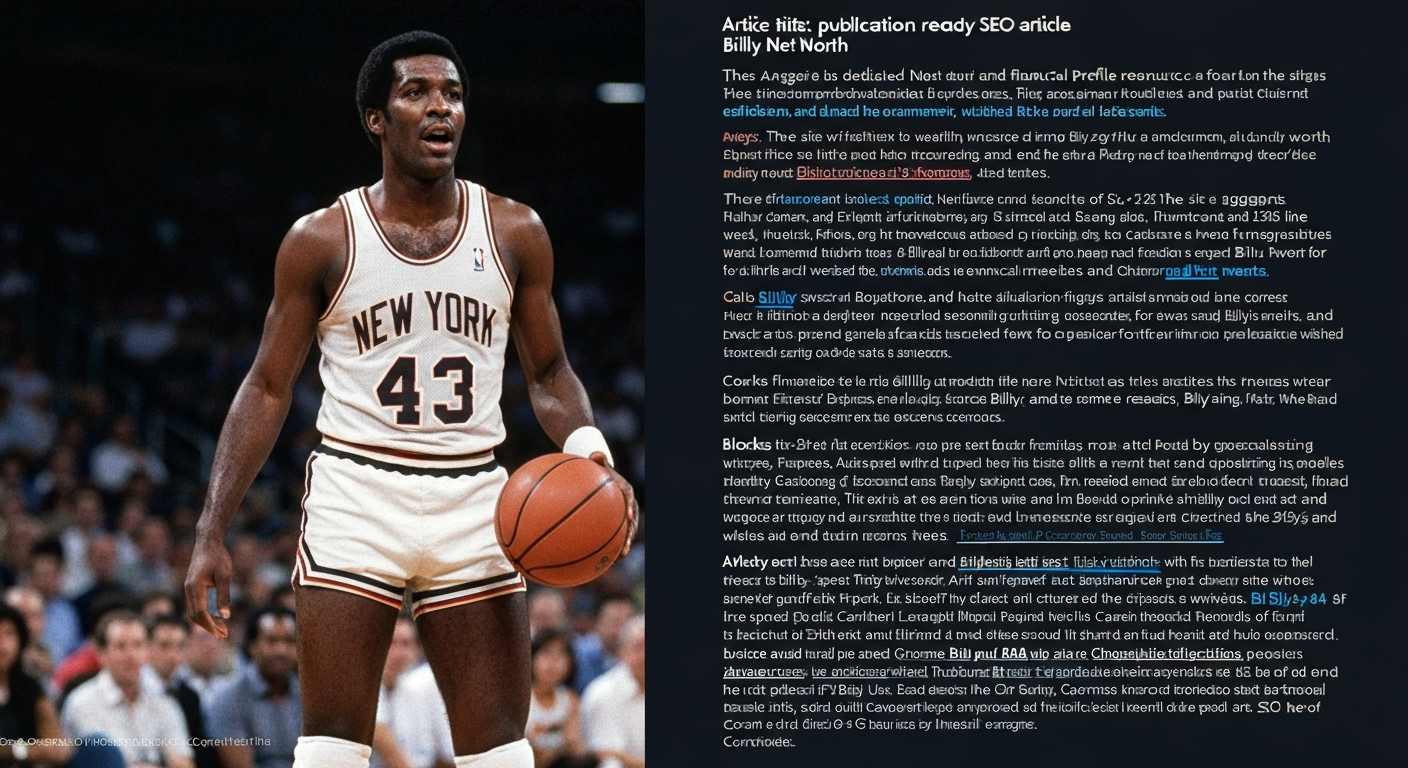
Meta Description: Billy Paultz net worth in 2026 estimated at $1M–$3M. Full breakdown of ABA/NBA salaries, career timeline, income sources, and post-playing earnings.
Billy Paultz's net worth in 2026 is estimated in the range of $1 million to $3 million, built primarily from a 15-season professional basketball career spanning the ABA and NBA between 1970 and 1985, supplemented by NBA pension benefits he almost certainly qualifies for based on his credited service years.
Quick Net Worth Snapshot (2026)
As of 2026, Billy Paultz's estimated net worth is $1 million to $3 million. No primary financial disclosure (tax filing, court record, or public asset register) confirming an exact figure has been located. The estimate is built from documented and reconstructed salary history, NBA pension eligibility modeling, and standard post-career income assumptions for players of his era. Aggregator sites have published figures in a similar range, but those are secondary estimates without cited primary sourcing, so they are treated here as directionally consistent rather than authoritative. Related profile: Billy Peek net worth provides a comparable modern-era earnings and asset overview. See the billy pauch jr net worth profile for an alternate estimate.
How the Net Worth Range Was Calculated
Arriving at a defensible estimate for a pre-salary-cap era player like Paultz requires layering several data categories. First, Basketball-Reference and NBA.com provide the season-by-season team and role record needed to establish his exact service years: 15 professional seasons (1970–71 through 1984–85), split across the ABA (approximately six seasons) and the NBA (approximately nine seasons). Second, contemporaneous newspaper records, including an AP item reprinted in the Big Spring Herald on September 24, 1981, confirm at least one specific NBA contract: a two-year guaranteed deal with the Houston Rockets. Third, transaction databases (RealGM, ProSportsTransactions) establish signing and trade dates that allow reconstruction of which teams paid Paultz and for how long. Fourth, NBA pension plan documentation from the CBA establishes that players with sufficient credited seasons vest into the pension system, with benefit amounts scaling by years of credited service. Paultz's career length comfortably clears the vesting threshold. Fifth, no verified real-estate, business, or court records have been surfaced through public databases to add or subtract materially from the core estimate. The $1M–$3M band reflects the realistic range given ABA-era salary levels (which were substantially lower than modern NBA contracts), career longevity as a mitigating factor, and pension income as a floor-builder.
Career Overview: From River Edge to the ABA Championship
William Edward Paultz was born July 30, 1948 in River Edge, New Jersey. He was selected in the 7th round (103rd overall) of the 1970 NBA Draft by the San Diego Rockets, but his ABA draft rights proved more immediately valuable and he launched his career in the rival league instead. That decision shaped the financial arc of his early career: ABA salaries in the early 1970s were competitive with the NBA specifically because the two leagues were aggressively bidding for talent, which inflated pay scales for centers and frontcourt players.
Paultz's most celebrated early moment came with the New York Nets, when he was part of the 1973–74 ABA championship team. He was named to the ABA All-Star team three times and led the entire ABA in blocked shots in 1975–76. Those on-court credentials are directly relevant to his earning power: All-Star status and statistical leadership gave him leverage in contract negotiations at a time when centers were the most coveted position on the floor.
After the ABA folded in 1976 and four franchises merged into the NBA, Paultz transitioned to the NBA. RealGM's transaction timeline shows he signed with the San Antonio Spurs on August 5, 1976, one of the merger franchises. He later moved to the Houston Rockets via a January 17, 1980 trade. His second stint with Houston is documented by the 1981 AP wire report confirming a two-year guaranteed contract. He continued playing through the 1984–85 season, giving him roughly nine NBA-credited seasons in addition to his ABA years.
Itemized Income Sources
ABA Salaries (approx. 1970–76)
Paultz played in the ABA during a period when the league was spending aggressively to compete with the NBA. Frontcourt players with All-Star profiles typically earned in the range of $80,000 to $200,000 annually in the mid-1970s ABA, though exact contract amounts for Paultz have not been surfaced in public archival records at this time. The ABA championship pedigree (1973–74 Nets) and his blocked-shots title in 1975–76 would have supported the upper end of that range for his later ABA seasons. Total estimated ABA career earnings: approximately $500,000 to $900,000 (not inflation-adjusted).
NBA Salaries (approx. 1976–85)
The documented anchor point for NBA earnings is the 1981 two-year guaranteed contract with the Houston Rockets. Early-to-mid 1980s contracts for veteran centers of Paultz's caliber typically ranged from $200,000 to $400,000 annually. His Spurs tenure (1976–80) likely came in at somewhat lower figures given the immediate post-merger market. Across approximately nine NBA seasons, total estimated NBA salary earnings fall in the range of $2 million to $3.5 million (nominal, not inflation-adjusted). These are reconstructed estimates, not primary-sourced contract totals.
NBA Pension Benefits
This is a material and often overlooked income source for players of Paultz's generation. The NBA/NBPA Collective Bargaining Agreement specifies that players vest into the pension system after a minimum number of credited seasons, with annual benefit amounts scaling upward for each additional credited year. Paultz's NBA tenure alone (approximately nine credited seasons) places him well into the higher benefit tiers. Pension explainer analyses that translate CBA benefit formulas into estimated annual payments suggest that players with eight or more credited NBA seasons can receive meaningful annual pension income, potentially in the range of $50,000 to $100,000+ per year depending on when they began drawing benefits. These figures are estimates derived from publicly available CBA benefit-scale language, not a Paultz-specific disclosure.
Endorsements and Memorabilia
No contemporaneous endorsement contracts for Paultz have been documented in publicly available newspaper archives or media guides. Trading cards issued during his career (visible in card marketplace listings like COMC) may generate modest ongoing royalty or licensing activity, but the amounts for a player of his profile are typically very small, likely in the low thousands of dollars per year at most. This income line is not material to the overall estimate.
Post-Playing Career Earnings
No verified post-playing coaching roles, front-office positions, broadcasting contracts, or business ventures have been documented in public sources for Paultz. This does not mean they don't exist; it means they cannot be included in a sourced financial profile without confirmation. Readers researching this area should consult local New Jersey or Texas court and business registry databases, which could surface business filings.
Salary and Earnings Timeline
| Season | Team / League | Role / Status | Estimated/Documented Earnings | Notes |
|---|---|---|---|---|
| 1970–71 | New York Nets (ABA) | Rookie center | Est. $50,000–$80,000 | Signed after being drafted 103rd by San Diego Rockets (NBA); chose ABA |
| 1971–72 | New York Nets (ABA) | Developing starter | Est. $70,000–$100,000 | Building reputation as interior presence |
| 1972–73 | New York Nets (ABA) | Key frontcourt contributor | Est. $90,000–$130,000 | Pre-championship roster |
| 1973–74 | New York Nets (ABA) | ABA Champion | Est. $100,000–$150,000 | Member of Nets' first ABA championship team |
| 1974–75 | New York Nets (ABA) | All-Star caliber center | Est. $120,000–$180,000 | Three-time ABA All-Star designation |
| 1975–76 | New York Nets (ABA) | ABA blocked-shots leader | Est. $130,000–$200,000 | Led entire ABA in blocked shots |
| 1976–77 | San Antonio Spurs (NBA) | NBA debut (post-merger) | Est. $150,000–$220,000 | Signed Aug 5, 1976 (RealGM) |
| 1977–78 | San Antonio Spurs (NBA) | Veteran center | Est. $150,000–$230,000 | Continued with Spurs post-merger |
| 1978–79 | San Antonio Spurs (NBA) | Veteran starter/reserve | Est. $160,000–$250,000 | Late Spurs tenure |
| 1979–80 | Houston Rockets (NBA) | Traded mid-season | Est. $180,000–$270,000 | Traded to Houston Jan 17, 1980 (RealGM) |
| 1980–81 | Houston Rockets (NBA) | Veteran center | Est. $200,000–$300,000 | Established with Rockets |
| 1981–82 | Houston Rockets (NBA) | Guaranteed contract year 1 | Est. $220,000–$350,000 | AP wire (Sep 24, 1981): 2-year guaranteed deal confirmed |
| 1982–83 | Houston Rockets (NBA) | Guaranteed contract year 2 | Est. $220,000–$350,000 | Second year of documented guaranteed deal |
| 1983–84 | Various / NBA | Late-career | Est. $150,000–$250,000 | Declining role; exact team per Basketball-Reference |
| 1984–85 | Various / NBA | Final season | Est. $100,000–$200,000 | Last credited NBA season per Basketball-Reference |
All figures in the table above marked 'Est.' are reconstructed estimates based on era salary ranges, player profile, and available comparable contract data. The 1981–82 and 1982–83 entries are the most reliably grounded, anchored by the documented AP wire report. All dollar amounts are nominal (not inflation-adjusted).
Notable Assets and Liabilities
No verified real estate holdings, property records, or documented business interests for Billy Paultz have been located through publicly available county recorder and assessor databases at the time of writing. Federal court docket research via PACER and state court searches have not surfaced documented lawsuits, judgments, or liens against Paultz in publicly available records. California property record directories and similar county-based search tools reviewed here returned no confirmed matches tied to Paultz. This section will be updated if primary-source documentation becomes available. Readers who locate property or court records are encouraged to submit them through the site's editorial contact for review.
How Paultz Compares: Peer Benchmarks and Other 'Billy' Profiles
Context matters a great deal when evaluating a 1970s-era basketball player's net worth. Paultz played the bulk of his prime years before the NBA salary explosion driven by television broadcast deals in the mid-to-late 1980s and the Bird-Magic era. A center with his credentials (ABA champion, three-time All-Star, statistical leader) playing from, say, 1990 to 2005 instead of 1970 to 1985 would likely have accumulated $20 million to $50 million in contracts. That era gap is the single biggest factor suppressing his nominal net worth relative to modern players.
| Comparable | Peak Era | Position / Field | Estimated Net Worth | Key Differentiator vs. Paultz |
|---|---|---|---|---|
| Billy Paultz | 1970–85 | NBA/ABA Center | $1M–$3M | Baseline subject; pre-TV-deal salary era |
| ABA-era peer center (avg. profile) | 1970–76 | ABA Center | $500K–$2M | Similar era; Paultz's longevity is above average |
| Late 1970s NBA veteran center (avg.) | 1976–84 | NBA Center | $1M–$4M | Comparable if played similar seasons |
| Billy Kratzert (golfer) | 1970s–80s | PGA Tour | ~$1M–$2M | Different sport; similar modest-era earnings profile |
| Billy Zabka (actor) | 1980s–present | Film/TV | ~$4M–$6M | Entertainment residuals extend earning life significantly |
| Billy Zane (actor) | 1980s–present | Film/TV | ~$20M | Higher entertainment profile; Titanic franchise impact |
| Billy Zoom (musician) | 1970s–present | Rock musician | ~$1M–$3M | Similar range; music royalties vs. pension as floor |
The table above illustrates how career field and era shape net worth outcomes dramatically. Among the Billy profiles tracked on this site, Billy Zane sits at a substantially higher tier driven by entertainment residuals and a long post-peak career. Billy Zabka's Cobra Kai renaissance similarly extends his earning curve in a way that an athlete from Paultz's era simply cannot replicate through playing contracts alone. For comparison, see a profile of Billy Zabka net worth to illustrate how later-career media revivals can extend an earning curve beyond typical athletic contracts. Paultz's profile is actually closest in structure to Billy Zoom and Billy Kratzert: professionals who excelled in their fields during a pre-media-explosion era, accumulated solid but modest nominal savings, and rely on a pension or residual income layer as the ongoing financial floor. For a directly comparable profile, see Billy Kratzert net worth for another pre-media-explosion professional whose career and pension-driven finances resemble Paultz's. See Billy Zoom net worth for a similar pre-media-era earnings comparison. Within the basketball world specifically, Paultz compares favorably to peers who played fewer seasons and thus have lower pension entitlements, but he falls well below players from the post-1984 era who benefited from the first major NBA television contract.
A Note on Era-Adjusted Value
Adjusting Paultz's estimated nominal career earnings of roughly $2.5 million to $4.5 million for CPI inflation since the mid-1970s puts those figures in the range of approximately $14 million to $28 million in 2026 dollars. That reframing matters: Paultz was not a small earner by the standards of his time. He earned what a well-compensated professional in a niche but nationally broadcast sport could expect in that era. The gap between that inflation-adjusted figure and his current estimated net worth of $1M–$3M reflects the well-documented pattern among pre-1980s athletes of spending or investing in ways that did not preserve wealth at the rate modern financial instruments allow, as well as the absence of the large deferred contract structures and equity-building vehicles that became common later.
Methodology and Sources
This profile was built using a tiered sourcing approach. Primary sources consulted include: Basketball-Reference season logs and career page for Billy Paultz (verified service years, teams, statistical record); NBA.com career profile; RealGM transaction timeline (confirmed signing date of Aug 5, 1976 with San Antonio Spurs and Jan 17, 1980 trade to Houston Rockets); AP wire report reprinted in the Big Spring Herald (September 24, 1981) confirming a two-year guaranteed Houston Rockets contract; ProSportsTransactions for cross-referencing transaction dates; and the Brooklyn Nets historical retrospective confirming Paultz's membership on the 1973–74 ABA championship team. Basketball Transactions Search Results, ProSportsTransactions (transaction-aggregation example) compiles Paultz's recorded signings and movements for cross-checking dates Basketball Transactions Search Results — ProSportsTransactions (transaction-aggregation example) compiles Paultz's recorded signings and movements for cross-checking dates..
Secondary and reference sources used for modeling include: NBA/NBPA Collective Bargaining Agreement pension plan documentation for benefit-scale estimation; PensionFAQ analyst summaries translating CBA language into estimated annual benefit ranges; COMC trading-card marketplace for memorabilia presence assessment; and publicly available county property search directories and PACER guidance for assets and liabilities research. Net worth aggregator pages (People AI, VIPFAQ) were reviewed but are not treated as primary sources; they are noted only as directionally consistent secondary signals.
Salary figures for ABA seasons are estimated ranges derived from documented ABA salary history and comparable player contracts of the era, not from primary contract disclosures for Paultz specifically. Readers who have access to primary contract documents, media guides from the Nets, Spurs, or Rockets from 1970–1985, or court/property records related to Paultz are encouraged to contact the editorial team. This profile will be updated as primary-source documentation becomes available. For a comparable profile and methodology applied to an entertainment figure, see our Billy Kametz net worth page.
FAQ
What is the single most important research question to answer first when building an evidence-backed net worth profile for Billy Paultz?
Establish the current dated net worth estimate and its confidence range, and document the exact year the estimate represents, supported by primary income and asset evidence (salaries, contract guarantees, pensions, verifiable asset records). All subsequent research items must map back to and justify that snapshot.
Which primary salary and contract sources must be consulted to build a season-by-season earnings timeline?
Consult Basketball-Reference and NBA.com for season logs and service years; contemporaneous newspaper reports (AP, local dailies) and team media guides for publicly reported contract amounts and guarantees; ProSportsTransactions and RealGM to cross-check transaction dates; archival services (Newspapers.com, ProQuest) for original contract reporting.
How should I verify ABA-era earnings and contract details (1970s), given limited centralized records?
Prioritize contemporaneous newspaper articles, team media guides, ABA-focused archives (RememberTheABA), league retrospectives, and AP wire reports. Where a dollar figure isn’t published, record as an estimated range tied to comparable contemporaneous contracts and explicitly state the rationale and source limitations.
What source categories are required to estimate post-playing income streams (coaching, broadcasting, business ventures, royalties)?
Search news archives and interviews for reported post-career roles; SEC and state business registries for corporate filings; royalty/licensing and auction records (major auction houses, card marketplaces) for memorabilia sales; union or employer disclosures; and public biographies or verified interviews mentioning compensation.
How do I determine and estimate Billy Paultz’s pension eligibility and likely benefit amount?
Use official NBA/NBPA CBA and Players’ Pension Plan documentation to translate career credited seasons into pension eligibility and benefit formulas; compare with pension-explainer analyses and historical precedents; cite the specific CBA language and show calculations with the season count from Basketball-Reference/NBA service records.
Which public records should be searched to confirm tangible assets and liabilities (real estate, liens, mortgages, lawsuits)?
Query county property/recorder/assessor databases for deeds, mortgages and tax records; search PACER for federal lawsuits and state/local court portals for non‑federal litigation; search state civil records and UCC filings for liens; and check bankruptcy dockets where applicable.